Cunicular intestinal membranous cells. Origin, differentiation and medical importance
Keywords:
origin, differentiation, rabbit, cecal appendix, membranous cellsAbstract
Employing confocal microscopy and Ki-67 and anti-vimentin monoclonal antibodies, this article provides insights into the origin and differentiation of membranous cells resorting to a previously unused model: the rabbit cecal appendix and highlights from this its medical relevance. Regarding their differentiation, the first signs appear in the crypt and match with cells undergoing the most accelerated division stage, while the cells that will complete their maturation in the follicle-associated epithelium and will associate with lymphoid elements are already predetermined before leaving the crypt. Regarding their origin, rabbit M cells originate from cryptal stem cells, as other intestinal cell lines do (enterocytes, goblet cells, and enteroendocrine cells). This study not only corroborates what has been reported in other animals but also highlights the medical importance of continuing to study the molecular pathways of M cell differentiation, given that they currently serve as a gateway for oral vaccines and, additionally, are considered useful for the administration of antigens in autoimmune diseases.Downloads
Download data is not yet available.
Published
2026-09-03
How to Cite
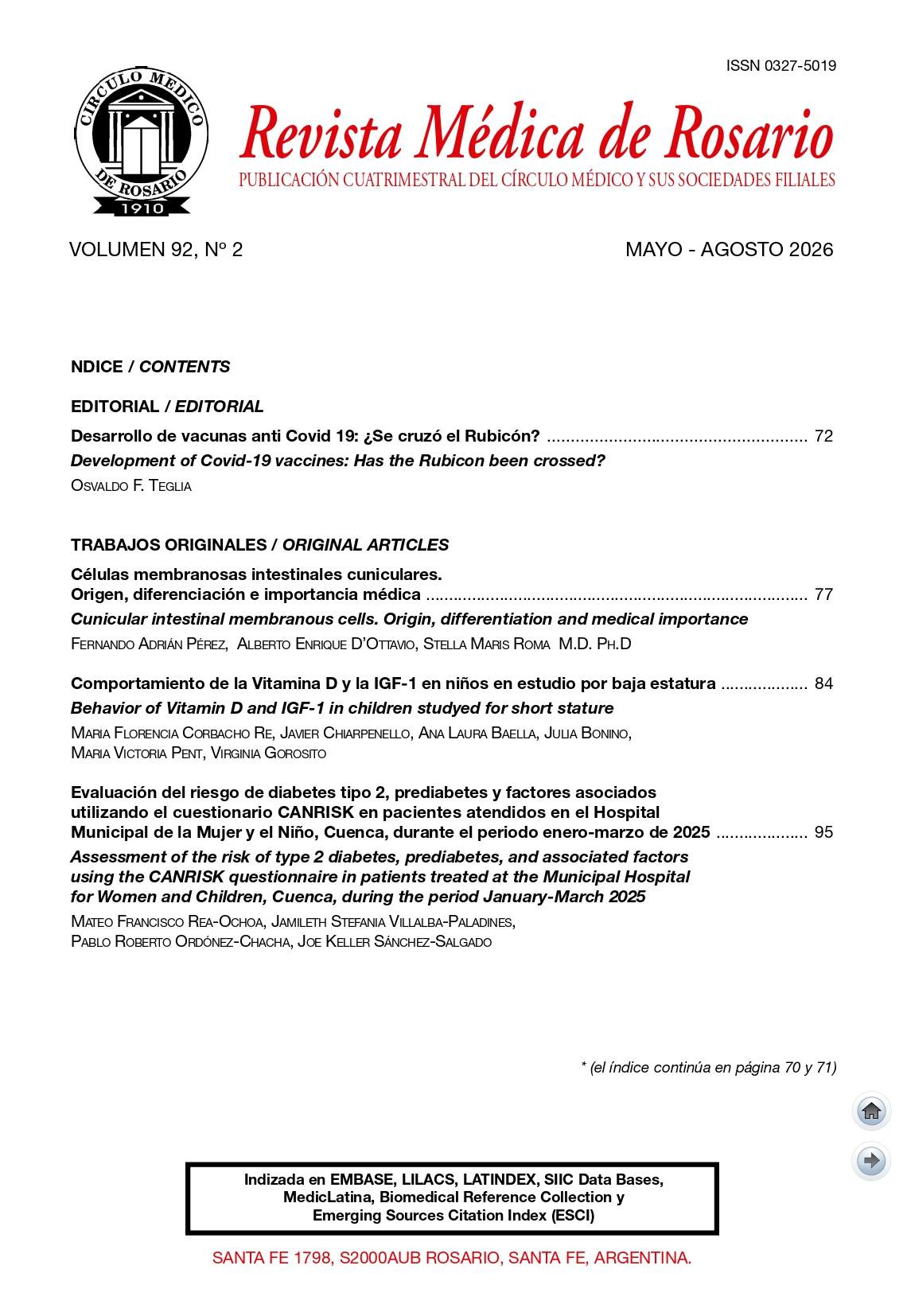
Pérez, F. A., D’Ottavio, A. E. and Roma, S. M. (2026) “Cunicular intestinal membranous cells. Origin, differentiation and medical importance”, Revista Médica de Rosario, 92(2), pp. 77–83. Available at: https://revistamedicaderosario.org/index.php/rm/article/view/celulas-membranosas-intestinales-cuniculares-origen-diferenciaci (Accessed: 3 September 2026).
Issue
Section
Original Articles
License
Copyright (c) 2026 Fernando Adrián Pérez, Alberto Enrique D’Ottavio, Stella Maris Roma

This work is licensed under a Creative Commons Attribution-ShareAlike 4.0 International License.
Licencia Atribución-CompartirIgual 4.0 Internacional (CC BY-SA 4.0)
https://creativecommons.org/licenses/by-sa/4.0/deed.es