Evidence of structural validity for the Verbal Auditory Screening Test for Cognitive Impairments (CAVAC)
Keywords:
neuropsychology, cognitive neurology, memory, cognitive impairment, dementia, cognitive screeningAbstract
Introduction: Dementias represent a global health challenge due to their increasing prevalence and high socioeconomic burden. In this context, the Verbal Auditory Screening for Cognitive Impairment (CAVAC, by its Spanish acronym) has emerged as a brief neuropsychological assessment tool developed in Argentina. Objective: To investigate the internal structure of the CAVAC through an exploratory factor analysis. Methods: A sample of 452 adults from the general population (Mage = 66.6) was evaluated, selected through non-probabilistic sampling in Rosario, Argentina. Results: The test displayed a three-factor structure explaining 38% of the total variance. Factor 1 was linked to attentional processes and working memory; Factor 2 was associated with executive functions (verbal initiation and abstraction); and Factor 3 grouped orientation and episodic memory. These findings provide the first evidence of structural validity for the CAVAC, confirming that its items are organized into theoretically coherent cognitive domains relevant for the detection of cognitive impairment. Conclusion: The CAVAC is a promising instrument for clinical screening. However, further research on its reliability and diagnostic performance in clinical samples is recommended to strengthen its utility within regional healthcare systems.Downloads
Download data is not yet available.
Published
2026-09-03
How to Cite
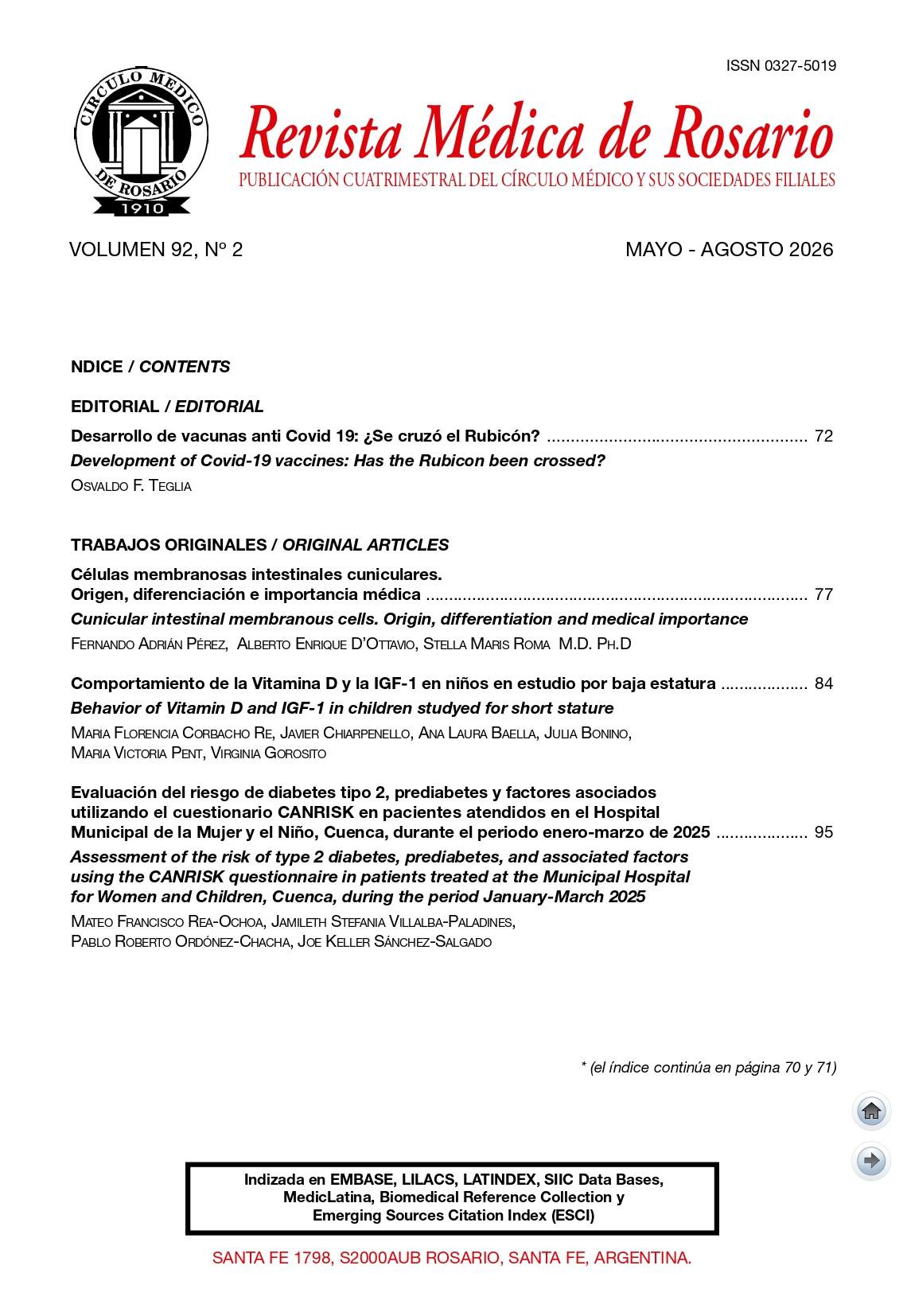
Martino, P. (2026) “Evidence of structural validity for the Verbal Auditory Screening Test for Cognitive Impairments (CAVAC)”, Revista Médica de Rosario, 92(2), pp. 119–125. Available at: https://revistamedicaderosario.org/index.php/rm/article/view/evidencias-de-validez-estructural-del-test-de-cribado-auditivo-v (Accessed: 3 September 2026).
Issue
Section
Original Articles
License
Copyright (c) 2026 Pablo Martino, Florencia Cossini, Mauricio Cervigni, Walter L. Arias Gallegos, Miguel Gallegos

This work is licensed under a Creative Commons Attribution-ShareAlike 4.0 International License.
Licencia Atribución-CompartirIgual 4.0 Internacional (CC BY-SA 4.0)
https://creativecommons.org/licenses/by-sa/4.0/deed.es